
Community Archive
社区档案
Dinu Li 李典宇
Dinu Li, born in Hong Kong in 1965 as the youngest of eight siblings, is a Hong Kong/UK photographer and multimedia artist who moved with his family to Sheffield in 1973 and then to Manchester in 1975. The bulk of the text, however, traces the life of Yuk Cho Lee, who arrived in Hong Kong from Taishan in the 1950s with nothing, at a time of economic stagnation and fierce job competition. He first rented a wooden shack in Tai Hang Sai, lost it to a landslide, and then bought a rooftop shack on Yin Ching Street in Mong Kok, sharing cramped, toilet-less quarters with more than twenty families from across Guangdong. Through a relative's connection, he found factory work, learned the mechanics of ribbon-weaving machines, and eventually rose to factory manager, gradually stabilising a household that had grown to include his mother, his four children from the countryside and four more sons born in Hong Kong.
His path into photography began in 1990, when he encountered the work of Chris Killip and Josef Koudelka in a Manchester bookshop. He taught himself to develop and print in a darkroom at Stockport College, became a photography assistant at Capricorn IV in 1992, and went freelance in 1993.
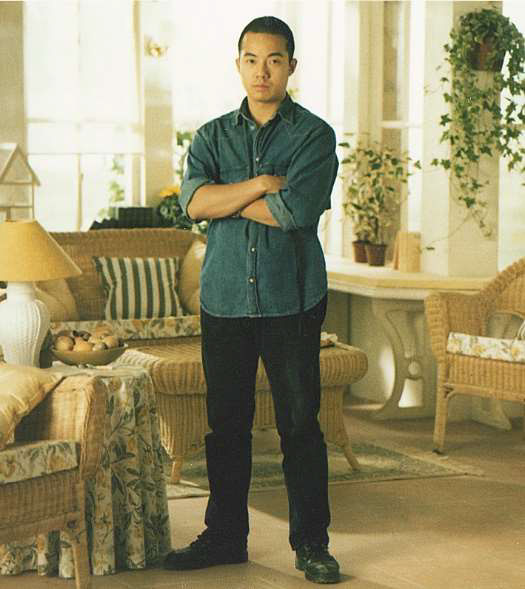
A Territorial Army recruitment poster he shot for the Ministry of Defence won a D&AD Award in 2000, and he graduated with a first-class honours degree in photography from Liverpool John Moores University in 2001. A formative 1997 journey to northwest Guizhou, China, documenting the Longhorn Miao people and their preserved traditions, set the tone for the culturally exploratory work that followed.
In 2005, he travelled with his mother to Hong Kong and her birthplace in Toi Shan, Guangdong, retracing her route from China to the UK. The resulting book, The Mother of All Journeys, was nominated for the Rencontres d'Arles Awards in 2007 and later made him a finalist for the WYNG Masters Award (2015/16, theme: Identity). His practice expanded from photography into film, video and sculpture, drawing on historical archives and everyday life. His film trilogy The Anatomy of Place (2007–2017), shown at Danielle Arnaud Gallery in 2018, combined Super 8, video, animation and personal archives to examine place and history in China, while his 2023 solo show A Phantom's Vibe explored colonial history, cultural memory and hybrid identity through music, sculpture and video installation.
Alongside his artistic career, Li has taught extensively: as a lecturer at the University of Chester (2009), head of photography at the University of Portsmouth (2014), and senior lecturer at Falmouth University (from 2015), where students voted him a Staff Excellence Award in 2016. He won the Association of Photographers' Lecturer of the Year award in 2019 and spoke at Tate Britain's Urban Encounters conference in 2017. His work features in The Chinese Art Book, and his works are also collected in Berlin, London, St. Gallen, and Zurich; he has exhibited internationally, including in Beijing, South Korea, and London.
To download the full document, click the button ~>
点击按钮下载完整文档
Yuk Cho Lee - 李旭初
Yuk Cho Lee was born in 1925 in Magang Village, Taishan, Guangdong Province, into a middle-class scholarly family; his father served as an Education Inspector for Guangdong and principal of Taishan County Secondary High School. He developed an early love of art, teaching himself calligraphy as a schoolboy without formal instruction. His education at Taishan County First High School was disrupted by the Japanese invasion, with Taishan occupied in 1941 and lessons repeatedly interrupted by air raids. In 1944, at nineteen, he married Yeuk Ling Yu in a match arranged by their families, and after the war, he taught at a primary school in his hometown.
War damage and political upheaval made life in Taishan difficult, and in 1955 he and his wife left their four children with his mother and went to Hong Kong. Arriving with nothing, they first lived in a wooden shack in Tai Hang Sai, which a landslide destroyed within a year, then in a rooftop shack in Mong Kok shared with more than twenty families, without toilets or private kitchens.
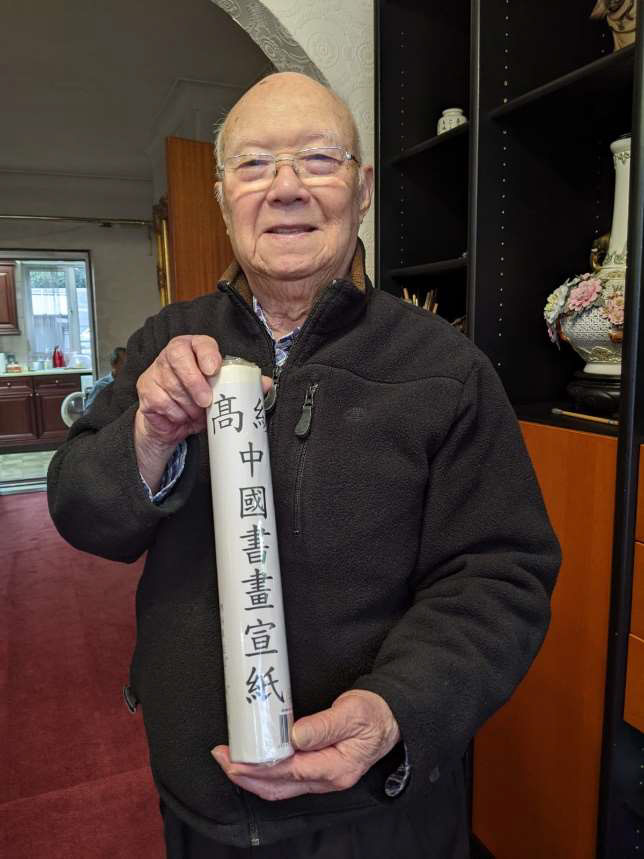
Through a relative, he found work at a lacquer factory and then a ribbon-weaving factory, where he studied the machinery and eventually rose to factory manager. Four more sons were born, and his mother and older children joined them, all living in a single small room while the eldest boys worked as apprentices to help support the family. By 1966 the family had moved to Canton Road, the most settled period of their Hong Kong years, but the 1967 unrest left him anxious about his children's future, and he successfully applied for a UK work visa.
In February 1968, he flew to London with his eldest son and travelled to Sheffield, where a friend ran the Concord Chinese Restaurant. He started as a waiter the next day while his son washed dishes, both facing long hours, low pay and a language barrier; he studied English late at night with audio tapes and a dictionary. The family moved to Manchester in 1975, where he was hired as manager of the newly opened Woo Sang Restaurant after a chance encounter in its convenience store. Known for his optimism, humour and warmth with customers, he thrived there as Woo Sang's authentic Cantonese cooking and dim sum helped shift local tastes away from the "chop suey" style. His account also documents Chinatown's growth from a handful of small restaurants among factories and warehouses to a thriving community with grocers, bakeries and professional services, its Spring Festival lion dances, and the 1987 building of the Chinatown Arch.
He retired in 1992, and in 1999, after thirty-one years in Britain, returned with his wife to Taishan to visit relatives and his old school, finding the village transformed. In retirement, he enjoys gardening, current affairs and learning to use a computer, through which he rediscovered Chinese calligraphy after a gap of several decades; he now practises daily, favouring semi-cursive script and transcribing Song Dynasty lyrics. In autumn 2020, four generations of the family collaborated on a family history book, which he named "Lee Yu Lau Fong", combining the surnames of the Lee family and the Yu family (shared by both his mother and his wife) and expressing the hope that their legacy flows on like the Yangtze. Of his seven sons and one daughter, four built careers in Hong Kong while the others remained in the UK; the account closes with him and his wife, surrounded by children and grandchildren, enjoying the rewards of a long, hard-won journey.